
Traditional workflow
Two visits, weeks apart.
- Goopy impression of the tooth
- Temporary crown cemented on for the wait
- Restoration ships to an outside lab
- Two to three weeks until placement
- Second appointment to remove the temp and bond the final
Flagship service
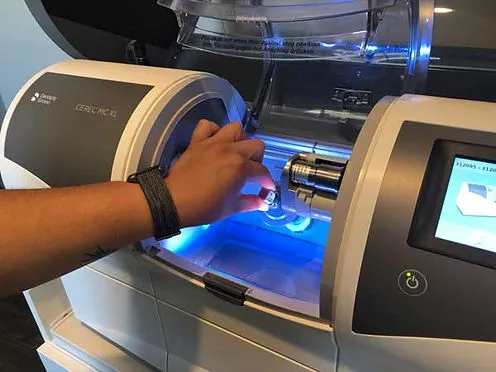
A digital scan replaces the goopy impression. We design your crown while you watch. We mill it in-house. We bake it in our porcelain oven. We try it in, adjust it, and bond it — in the same chair, the same visit.

The basics
A filling replaces a small area of decay. A crown is different: it covers the entire outer surface of the tooth. When decay is extensive, a previous filling has failed, or the tooth is cracked, a crown restores full strength and appearance.
The crown is cemented permanently in place. It looks and feels like a natural tooth, and it lets your original tooth stay in its socket — no extraction needed. Crowns last longer than fillings and protect the tooth from further damage.
At Crossroads, all crowns are milled in-house from high-strength ceramic. That means one appointment — no goopy impression, no temporary, no waiting weeks for a lab.
See how it works
What changes
Traditional workflow
Crossroads workflow
Why two mills
If you need crowns on more than one tooth, two mills let us work on both restorations at the same time. Your visit stays efficient even when the work is more involved — no waiting for one to finish before the next begins.
Mills also need routine maintenance — it’s part of keeping them in top condition. A second mill means that when one is scheduled for service, the other keeps your appointment on track. No reschedules, no surprises.
We made the investment so the same-day promise is a real one, built to hold up in real situations.
What an appointment looks like
01
Digital scan.
The intraoral scanner builds a precise 3D model of your tooth in minutes — no goop, no gag reflex.
02
Design together.
We design the crown on the monitor while you watch. You see the shape, the fit, and the bite before anything is milled.
03
Milled in-house.
The CEREC mill shapes your crown from a solid block of ceramic — right here in the office.
04
Glaze and fire.
Into the porcelain oven to glaze, fire, and finish the surface. This is where the natural look gets built.
05
Try-in and bond.
We try it in, check the fit and bite, adjust as needed, and bond it permanently. You walk out finished.
Crown materials
Very high strength — good for back teeth that take heavy chewing pressure. Gold or silver in color, which makes them visible. An older material that has largely been replaced by ceramic.
A metal shell with a porcelain outer coat. More natural-looking than full metal, but a thin dark line can sometimes show at the gum line. If you have older crowns with metallic edges, ask us about replacing them with full ceramic.
What we use
Ceramic matches the color and light-reflecting properties of natural enamel. No metal, no dark edges. The blocks milled in our CEREC unit are high-strength ceramic — the best esthetic result and the best fit for a same-day restoration.
Why crowns work
In our office
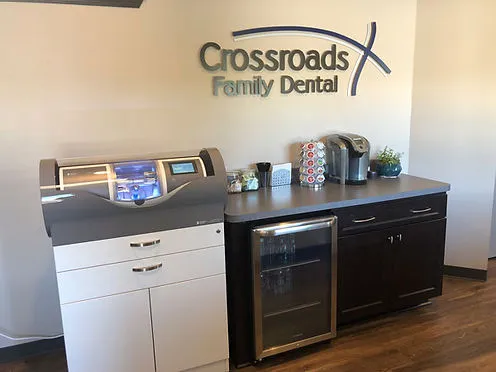
The milling unit sits in our reception area with a viewing window. While you wait, you can see exactly what’s happening — the machine cutting your crown from a ceramic block in real time. It’s one of the more interesting things to watch in a dental office.
If you’re considering a crown, start with a first visit and we’ll walk through your options together.